
The business case for emerging project management software and collaborative work platforms, such as Podio, is a very strong and compelling one. Podio is one of many Enterprise Social Networks (ESN’s) now available to Companies that are seeking new ways to improve workflow, collaboration and gain increased efficiency.
ESN’s such as Podio are becoming an alternative that many businesses are exploring. This is part two of three in the Podio Series of posts where-in the first post focused on the basic features and benefits of the platform. This post will outline the business case for incorporating an ESN into a business and the third and final post will examine the more advanced features and the benefits of implementing these features into a business process.
The Business Case for using Podio
The initial Podio post introduced the following benefits that business can leverage from the implementation of Podio. These business benefits are a strong consideration when choosing to engage an ESN and apply it to an internal workflow process.
- Increased efficiency within your business
- Improved collaboration among team members
- Secure location for all your project management
- One location for all mission critical and case sensitive documents
- Log-in can take place from anywhere in the world, from any device, at any time of day
- You can add in clients/people from outside your business to their project securely within that project workspace
All of the above are vital methods of enhancement of business processes and are examined in more detail here.
Increased Efficiency
Adopting Podio increases efficiency on many levels within your business as it allows clarity and ease of locating people and documents. Podio also allows people to:
- Locate the inhouse experts
- Encourages bottom up communication
- Enables innovation
- Companies can react swiftly to changing circumstances
- Remove barriers created by old style management protocols
- Eliminates silos
- Reduces the need for email
In the video below you will hear how Plinga have leveraged Podio to remove Silos and duplication of workload.
Key Insights from the Plinga Case Study
- Replaced Google Docs, Excel Spreadsheets and 80% of email with one platform
- Podio brought the business development and project teams closer together
- Plinga have seen a marked reduction in miscommunication and duplication of work
- Reduced their spend on different platforms, they now only need one
Collaboration
Increased collaboration will only come with adoption of the users within the platform. The roll out has to be strategic and carefully planned thereby gaining maximum buy-in from all members at all levels within the company. When Podio is introduced to a business, the aim is to achieve full scale acceptance and a high level of enthusiasm from the user. To do this:
- Set meaningful goals
- Create an effective launch
- Manage the adoption cycle
- Leverage your internal champions to drive peer to peer learning/usage rates
A good early adopting rate will run at between 20% and 40%, these early adopters become your advocates. They also help to train/apply peer pressure on the other non-adopters. Your plan should have milestones as to how quickly the remaining staff will join the platform.
Businesses that experience high levels of collaboration report increased efficiency and raised levels of productivity. It is also noted that high levels of collaboration and internal communications can lead to a happy workforce with less sick days and a lower staff turnover which, in turn, drives profitability.
When rolled out successfully ESN’s can also assist in:
- Increasing your businesses ability to react quickly to changing circumstances
- Empowering innovation
- Removing top down structure
- Promoting inclusive communication
- Raising engagement
Example: Simply Business are an English Insurance Brokerage with 180,000 client company’s. They initially utilised Podio as an intranet however have now adopted all capabilities across all functions within the business
Key Insights from Simply Business Case Study
- Internal collaboration has increased dramatically
- Displays the ease of app customisation to adapt to business flow
- Podio allows a central hub for all project and document storage accessible from anywhere
Secure Location for Project Management
All web, application and database servers supporting Podio reside within highly secured worldwide data centers. Podio is owned by Citrix.
Podio places great emphasis on user identification. All users must be registered using a validated email address which is associated with an identified organisation.
Citrix takes the privacy, security and protection of all data very seriously. They have built Podio around this priority. Citrix security policies and controls align with industry standards. These standards are constantly reviewed to ensure continued compliance.
One Location for all Mission Critical Documents
Picture the scene: Friday evening at 2 pm a major existing client contacts your office. The person in charge of the account is on a half day and the client wants a task completed that afternoon, without fail. Currently most companies would be thrown into a panic as the documents are stored on different hardware, disk drives, mobile devices and nobody can locate the correct information. The account manager cannot be contacted.
One of the benefits of Podio is that there is no need to disturb the account manager on his/her time off as
- All relevant client documents are uploaded to a Project space on Podio.
- All previous interactions with the client are logged in the activity stream
- As the documents can be easily located the task can be turned around quickly
- All contact details relating to the client are stored in the project space
Large or small business can be faced with these business critical challenges. They need not be a major incidence as Podio helps to eliminate these types of issues.
Log-in from any Location
A key benefit of Podio is that it can be used across all mobile platforms and accessed from any location in the world with Wi-Fi. One of the strongest emerging trends in business is remote workers and the emergence of the Bring Your Own Device (BYOD).
In a recent Forrester Report some interesting statistics emerged around the mobile worker and how emerging mobile, BYOD and cloud based technology is changing the way workers are carrying out their daily work cycle.
- 29% of the knowledge base workforce are now anytime, anywhere workers
- 37% work from multiple locations
- 53% use multiple devices
- 82% use many apps to do the daily work
In this Podio case study you can see how a Chamber of Commerce reacted swiftly to the breaking news story of a business closure in their Town, despite the team being in different countries.
Key takeaways for the Clonmel Chamber from their case study.
- High adoption levels among the staff as they gained experience using Podio
- The ease of arranging the St Patricks Day event both internally and externally
- The ability to use Podio across all platforms
Introduce your Clients
Adding your clients into a Podio project space allows increased collaboration. The client is able to see the ongoing work on their project in near real time. It is very simple to do, all it takes is their email address, you set the permissions to the correct level so that you control their ability to interact in the space.
Conclusion
Enterprise Social Networks are gaining momentum within organisations, as the user experience improves and the features and functionality increase. As development companies like Podio leverage the communication characteristics of the Social Media platforms on which people now spend so much time and also incorporate strong business methodology. Providing the various functions within business with secure, efficient and mobile workspaces; adoption levels will continue to rise quickly.
Can your business afford not to embrace Podio in today’s digital economy?
This is part 2 in a 3 part series on Podio, the last post will delve deeper into the more sophisticated features and functionality available to your team.
Podio.com has been utilised as a reference and for video and images.
Understanding the Digital Economy
Reports:
- Travel and Tourism
 E-Commerce
- Food and Drink Sector
- International Student Recruitment
- General and Health Insurance
- FMCG Sector – Retail and Ecommerce
- Attracting Top Tier Talent
- Social Media in Politics
Guides:
Contact us
If you would like to talk to The Ahain Group about Podio please feel free to contact us.
Connect: 


Podio is a very special platform with brilliant features and functionality. Podio is a new project management software and collaborative work platform to emerge over the last few years along with the likes of Jive, Yammer, BaseCamp and others. This is the first of a three part series on Podio. When we reviewed these project management software and collaborative work platforms for use at The Ahain Group, we found Podio’s flexibility and intuitive set up to be a real eye opener. Disclosure: We liked the platform so much we have since become Preferred Partners to Podio in Ireland.
What is Podio?
Podio is an online project management software and collaborative work platform that can be used by any business or organisation, allowing staff to work collaboratively in a secure and non- technically challenging environment.
- It allows for the handling of multiple projects, document sharing/storage and everyday management of workflows within any business or organisation,
- Podio unites your team, content, tasks and communications, enabling you to manage projects and run business processes like sales, recruiting and more – without email overload and document chaos.
.png)
The business case for using Podio
- Increased efficiency within your business
- Better collaboration amongst team members
- A secure location for all your project management
- One location for all mission critical and case sensitive documents
- Log-in can take place from anywhere in the world, from any device, at any time of day
- You can add in clients/people from outside your business to their project securely within that project workspace
Pricing and Plans
There are three options available for membership:
- Podio Lite (free) - This option allows you to have 5 users internally and 5 externally with access to the core features and Apps.
- Podio Teams (paid) - This option allows you unlimited employees and you have unlimited external team members at no extra charge. This gives you full access to core features and Apps plus access rights and control. It is $15 per month and you can avail of 20% discount if you commit to a yearly plan.
- Podio for Business (paid) - This option is for large business or enterprise clients. It includes all the mentioned features plus personalised training and support. Podio do not include a pricing plan on this option, they ask that the business contacts them directly to discuss their needs.
Setting up
- Go to the Podio sign-up page
- Enter your work email address
- Click on sign-up
Note: you can also use Facebook, Google, Windows Live or Go To Meet
Complete your profile
After you have signed-up you need to edit your profile:
- Click the profile icon in the top blue bar,
- then select “My Profile” and “Edit Profile”
- and set your permissions on notifications.
Make sure to include your avatar/picture as people are happier interacting with you when they can see your picture.
Invite work colleagues
You can then add all your fellow employees in a few clicks by using your contacts from Google, Outlook or vCards. Alternatively, you can manually enter the email addresses of the people you would like to invite.
Post an update in the stream
To post a status update you type your message in the dialog box and you can then include or leave people out of updates by using the @mention feature. This is a similar feature to tagging on Facebook. The update will be in the stream for everyone to see in the employee work stream. Those @mentioned will get an update of the mention, depending on how they have configured their personal profile.
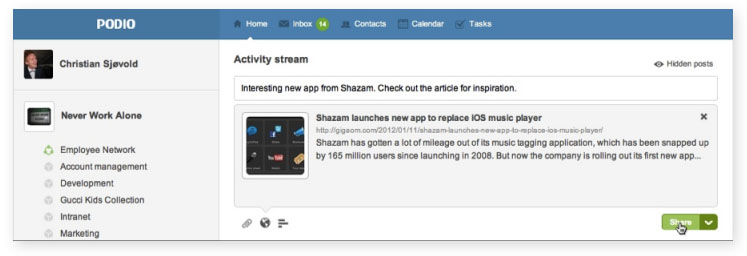
You can also add the following below the update:
- Share a File
- Share a Link
- Share a Question
The icons are clearly visible below the dialog box.
Live chat
This is a recently added feature which allows you to click on the avatar in the Chat bar of the work colleague or colleagues you wish to “live chat” to. It allows you to discuss an ongoing project without having to leave the Podio platform and cuts down on emails or phone calls as the “chat” is in real time.
Employee Network
The Employee Network is a place to communicate with your entire company.
Within your Employee Network’s activity stream you can share:
- Status updates,
- files,
- questions,
- links,
- images,
- and tasks.
Sharing something in the Employee Network could be used instead of internal email when wanting to share and discuss things with the entire organization.
Workspaces
Workspaces are for specific groups of people within your network/business who are working on projects or ongoing processes; a place for project teams to complete their daily workflows, share documents, collaborate and interact with one another.
- People generally name their workspaces after departments, clients, teams or projects, e.g. “HR”, “Sales” or “Project Podio “.
- You can then invite internal or external collaborators and add apps to get your work done. All the members of an organisation’s Employee Network can create workspaces in that organisation.
- External members cannot create workspaces within your organisation.
- Click the “Create workspace” button in the left navigation.
- Then set basic permissions for the workspace.
Workspaces can either be:
- Open, whereby your whole organisation can see them,
- Or private, meaning they are strictly invite-only.
Open workspaces can also be set to auto-join. That means any new employee signing up for Podio will be automatically added to the space. Note: auto-joining does NOT affect existing users.
Podio Apps
This for me is the distinguishing feature of Podio.
All workspaces come with some apps already installed and you can further add/remove apps so as to customise that workspace for your particular needs. You can archive these pre-installed apps and restore them later if necessary.
- Click the wrench icon to the right of the app, and then select Archive app. Or, click the wrench icon next to the workspace name in the left navigation and select “Manage apps”. You can archive any of your apps from there.
- If you’d like to un-archive an app, you can do so via the “Manage apps” menu.
Apps Market
There are hundreds of pre-prepared apps that are readily available in the Podio app market. The App Market is accessible via the “Add App” button at the top of any workspace.
Getting apps is free and can be done in seconds:
- Use the “Find an app” search tool in the upper left corner of the page to search for an app, or browse popular apps that other Podio users have found useful for them.
- When you’ve found an app you wish to install, click the green “Get App” button for that app, select the workspace you wish to add it to, and the app will then be added to that workspace.
The Apps and Apps market allows a very high level of customisation. I have only touched the surface here but will expand on this over the next two posts in this series.
Creating tasks
There are a number of ways to create tasks on Podio:
- Click the task icon in the top blue bar. This is also a complete overview of your existing tasks, tasks you delegated, and tasks you are working on.
- You can create a task via email - hit the “Create a task from email” link in right side.
- You can give a task to someone on Podio by going to their profile page and adding it from there.
- On any app item in Podio e.g. a deliverable or a meeting, just press the task icon in the right side bar to create a task. It will be attached to the item.
- On a workspace, press the task icon, and start creating tasks for that particular group of people.
- If you’ve added the Podio Google Gadget you can create tasks right out of your emails in your Google Apps Gmail inbox.
- You can assign tasks to anyone, even people not on Podio yet.
Using tasks and apps together
Podio ROI
Here are just some examples of Podio ROI:
- Economy - See how Clonmel Chamber of Commerce is helping the local economy with Podio.
- Marketing - Discover how the Cirque du Soleil marketing team from Las Vegas use Podio to run their marketing processes.
- Education - See how ESA are revolutionizing how they deliver education with Podio.
- Eliminate Silos - Read about how Plinga eliminate silos and double bookkeeping with Podio.
- CRM - Discover how Podio provides a flexible and mobile CRM for Ekito.
Conclusion:
Podio is a clever and easy to use platform that has been designed with both people and business in mind. You can bring your people, projects and workflows to Podio without having Podio impose its workflow style on you.
Please check back with us for parts 2 and 3 in this series on Podio, where we will be providing you with additional guidance on how to get the most from the platform, and taking you through the apps features and functionality in more detail. Acknowledgement: I have used Podio.com as a reference point and for videos & images.
Understanding the Digital Economy
Reports:
- E-Commerce
- Food and Drink Sector
- International Student Recruitment
- General and Health Insurance
- FMCG Sector – Retail and Ecommerce
- Attracting Top Tier Talent
- Social Media in Politics
Guides:
Contact us
If you would like to talk to The Ahain Group about Podio please feel free to contact us.
Connect:
As a child television was for me, 1 then 2 channels and I can even remember black and white programmes. We did not have computers at all, they were introduced into my school in 1978. We most certainly did not have mobile phones. Hold on, it’s not that long ago, I am only 46. The speed of change is startling and difficult to stay ahead of.
Future in Focus white paper from ComScore
Today I was reading the Future in Focus 2012 white paper from comScore called US Digital, and the stats are amazing. They cover all aspects of online behaviour, such as:
- Social
- Portals
- Video
- Mobile
- E-Commerce
- Multi-Device Digital Omnivore
This is a new term for me but it describes the fact that people are now viewing online through smart phones, tablets, note books, lap-tops and in some cases simultaneously. 8% of all online viewing was via mobile in the US last year. The “Multi-Device Digital Omnivore” is going to drive that figure higher.
Social
Facebook is still the number one, most viewed Social Platform with Twitter now second, this is as a result of Twitters hook-up with Apple’s iPhone. Facebook’s membership is still growing but the more interesting stats include:
- The average time people engage is up by 32%,
- Facebook now accounts for 15% of all views online.
- Google is the most used Portal but again this is on the back of it’s purchase of YouTube, video is helping to cover the problems Portals are having. Surprisingly Google’s figure is only at 10.80% of all online views.
- The traditional portals are the big losers, Yahoo, MSN and AOl all losing out to the shift to Social via Mobile.
- The two big winners in Social are Pinterest and Tumblr, both registered huge growth during 2011, with Pinterest not registering at all in July of the year.
Long-form video content
Some statistics on video:
- Over 100 million Americans viewed online video in 2011 up 43% on 2010, these videos are also getting longer.
- With the average viewing up 1 minute from 5 to 6 minutes.
This may not sound a lot but is largely down to Netflicks and Hulu’s on demand service for movies and TV series.
The number of streams viewed also jumped dramatically up 44%. - Marketers are again being challenged to come up with the correct way to leverage all the online traffic.
Mobile
The Omnivores are actually surfing during the adverts on TV, the switch to mobile is allowing this behaviour to flourish. As the dumb phones are replaced over the coming years the viewing figures from smart phones is going to drive this trend.
There are close to 4.8 billion dumb phones and 1.2 billion smart phones world wide
the majority of dumb phones are going to be replaced shortly with smart phones.
In lower socioeconomic countries the smart phone may represent the only “computer” that people are going to own.
What will they use it for? To buy goods via the net, engage with Social Platforms and in a world where pictures paint a thousand words, video will boom.
E-commerce
Our retailers have huge competition from the web but all we ever hear about is rent, rates, wages and recession, recession and recession. Well, WAKE-UP it’s more to do with the e-commerce on the web.
Cyber Monday 28th Nov last year in the US, citizens spent $1.251 billion
and another 10 days around the holiday period broke the $1 billion barrier online.
We are still waiting for the figures here in Ireland but the anecdotal evidence is that the figures were up. Some delivery companies had difficulty making all their deliveries pre-Christmas. Santa was late in some cases.
Conclusion
The “Multi-Device Digital Omnivores” are going to continue the trends set over the last couple of years. As the mobile market grows so will the online viewing habits of the world population. What ever about TV and traditional media, e-commerce will grow into the future. If the offline retailers do not grasp this quickly they are dead.
The retail company Game closed it’s Irish retail outlets this week, more will follow. Angela Ahrendts the CEO of Burberry believes that the ROI of online Social Business is, any company that does not embrace the changes will not exist in 5 years.
Why has Game closed it doors, online………
Thanks to comScore for the white paper it is enlightening and required reading for all business with or without an online presences. It may be the US market but it follows here in Ireland and the UK.
Thoughts on the Multi-Device Digital Omnivore….
Objective
When Muthar Kent the new CEO announced in 2008 that Coca-Cola sales had to double by the year 2020 I would guess that the executives were checking the calendar, but it wasn’t April fools day.
Background
Kent’s predecessor Neville Isdell had identified that Coca-Cola had become stagnated, inward looking and arrogant. He had started the process to open up the company by inviting 400 top overseas executives and Coca-Colas bottling partners to discuss how they had gotten into this position. Muthar Kent’s growth initiative was the next step in re-establishing Coca-Cola as an innovative, risk taking organisation, where risk taking is now becoming the life blood of the company.
Kent’s announcement reminds me of the Henry Ford story, when he told his engineers that he wanted a 8 cylinder engine on one block, they said it couldn’t done. Ford was unmoved and demanded they produce it. Failure after failure followed but Ford kept sending the engineers back until eventually 18 months later they succeeded and produced the V8 engine, the most popular engine in motoring history. Maybe Kent had taken a similar stance.
Included in Kent’s demand was the US market, the executives told him that Coca-Cola were maxed out in their home market. Kent again disagreed and told them find away to deliver his vision. There followed a clear-out of those who were blocking the path and it was clear that a new marketing model with-in Coca-Cola was needed to achieve these ambitious demands.
How to deliver objectives
In 2007 Coca-Cola spent 3% of it’s marketing budget online. This was about to change radically, enter Jonathan Mildenhall and his marketing team.
“All advertisers need a lot more content so that they can keep the engagement with consumers fresh and relevant, because of the 24/7 connectivity. If you’re going to be successful around the world, you have to have fat and fertile ideas at the core.”
The online budget is now 20% and rising, at the end of 2011 Cola-Cola where on target for their projected growth even in the US market. How has this being achieved?
Developing the Strategy
Content marketing online has being the key to this growth. Coca-Cola have had a tradition of telling great stories thru it’s advertising. The “Holidays are Coming” advert, springs to mind immediately. Coca-Cola recognise that story telling is a tradition in every country and ethnic culture world wide.The trick is to create contagious content which would earn Coca-Cola a disproportionate amount of reaction and discussion across all channels and platforms.
The Strategy
These two YouTube links are cartoon videos explaining how the online campaign works and the strategy behind the content creation and distribution.
Overall, the videos are twenty minutes long and contain the entire creative content strategy to achieve the correct result for Event 2020. Outside of being compulsive and required viewing, they pose a great question, why? Why have Cola-Cola posted these on YouTube for all to see?
Three answers:
- it is part of online culture to share, it lends to the authenticity, which is central to Coca-Colas online policy.
- by posting the strategy Coca-Cola are creating a conversation, part of the disproportionate discussion they are trying to achieve.
- these were up-loaded in August 2011, 2 years after the plans inception, so the opposition are already 2 years behind Coca-Cola, you can be sure Mildenhall and his team have already raised the bar internally.
Implementation
With approximately 500 products spread all over the globe, Mildenhall and his online marketing team set about developing a strategy which allowed them to leverage this vast resource. They also spent a lot of time reviewing data, which they refer to as the new soil. One major advantage to online marketing, it allows greater in-debt access to metrics. These metrics are a rich and fertile source for the development of strategy.
They also recognised that they did not have to create all the content on their own. By listening to their community they knew they would receive ideas as part of the discussions. It was also accepted that mistakes would be made, particularly when they are talking risks. This acceptance is crucial as it frees the creatives, allows them to work with-out fear.
Fanta is big brand within the Coca-Cola stable and they ran a advertising campaign featuring a cartoon girl at a party walking into a clear glass wall. To recover from the embarrassment, she starts to mime and she becomes the main attraction at the party.
A good advert but then comes a spoof of the advert, a man with a beard dressed the same way as the cartoon Fanta girl, making all the same moves. Both were a huge success.
Deciding on a 70%>20%>10% break down of content
The marketers in Cola-Cola operate to a 70>20>10 break down. The whole Fanta campaign has over ten 30/35 second adverts which are based around the Fanta girls and guys having fun, this is the bread and butter 70%. The spoof mime advert is in the 20%, which has some risk and will become part of the 70% in time. They also ran some interesting gorilla type stunts such as the link below, this is in the 10% group, lots of risk.
Constructively Discontent
This campaign shows that dynamic story telling does work and it can be risky, the man in the spoof advert has a beard and is dressed as a women. Not every large organisation like Coca-Cola would allow such risk taking. Muthar Kent actively promotes the concept of being “constructively discontent” among his marketing executives. Mildenhall finds this concept very liberating as the result thus far show.
Result
Overall an incredible online content marketing initiative, embracing new tools and channels by one of the worlds biggest brands. Coca-Cola have moved from being inward looking and arrogant, to being one of the world leading examples of a Social Business, using cutting edge online strategies. Not many large corporations could achieve this pivot in such a short time frame.
We have a wait to see if they achieve their overall goal, one thing is already clear, over two years into a ten year plan and Coca-Cola are very happy with the progress.
PocketNative™ is a wholly new service for the Hospitality & Tourism sector, offering an utterly unique and exciting travel and touring experience to the traveller and promotional platform for the service provider.
Having just launched in Ireland and in the U.S., the concept of creating an on-line event to promote Ireland in a positive light during the visit of President Obama, was suggested. In early April, using Twitter™ as the primary social networking channel, “#IRLDay” was conceived.
The objective:
The primary objective of #IRLDay was to create a unique, on-line event to promote Ireland – especially as a tourist destination. Achievement of that objective necessitated:
- initiating of a media campaign on Twitter™, leveraging the tourism groups already operating.
- making the Irish blogging community aware of the event and getting their support/involvement
- gaining support from Taoiseach’s Office, the Department of Tourism, and the Northern Ireland Department of Tourism
- gaining support from Tourism Ireland, Fáilte Ireland, Discover Ireland and the Northern Ireland Tourism Office, Bord Bia.
- gaining support from the main Independent Tourism Groups in Ireland such as RAI, IHF, IHI, B&B Ireland, Good Food Ireland and Irish Foodies (to name but a few)
- getting coverage in Newspapers and on TV and Radio
The challenge:
“Conventional advertising and promotion is rapidly disappearing—being replaced by on-line promotion using Social Networks. This is recognised by only a tiny proportion of the Irish Industry & Commerce community. The principal challenge therefore was to achieve ‘buy-in’ for #IRLDay within the Hospitality & Tourism and related sectors,” said John Twohig of PocketNative.
What happened:
On April 15th, a campaign was initiated on PocketNative™’s Facebook™ page and the #IRLDay hash-tag stream was initiated on Twitter™.
An Taoiseach’s Office supported the event through its Twitter™ account @MerrionStreet and Transport Minister, Leo Varadkar, issued a Press Release on the day of the event. The US State Department @Americagov, the U.S. Embassy in Dublin and the Dublin-based U.S. Chamber of Commerce also joined the campaign. All of the Irish Tourism Bodies, along with all the independent groups above, joined in the event, plus others.
Business was not targeted initially, but during the campaign, Enterprise Ireland, IDA Ireland, Science Foundation Ireland, ESB, KPMG, Microsoft Ireland, Paddy Powers and other companies requested inclusion in the event. Dr Theo Lynn at Dublin City University kindly offered DCU facilities to monitor the day’s events. This support was critical to the participation of An Taoiseach’s Office, Tourism Ireland and all U.S. Government involvement, as they would not have done so without adequate monitoring and security.
The Twitter™ community embraced the event with enthusiasm and helped grow it nationally and internationally. Huge support from the blogger community was evident early with Naill Devitt of Bloggertone – the largest Irish blogging community – putting his full weight behind the event.
The results:
Overall, the event was extraordinarily successful. All participants were tremendously supportive, complimentary and delighted with the results achieved. Twitter™ results showed :
- 17,000+ tweets appeared with the hash tag #IRLday from the 15th April to 25th May
- 12,800 tweets with the #IRLday hash tag on the 23rd May
- 4,000+ people participated in #IRLday from all over the world.
- #IRLday trended in Ireland on the 23rd and 24th May; the second day was not expected
“#IRLday showed that Ireland is once again leading the way with Social Media. #IRLday was the first ever initiative to market a country in a positive light by ordinary people—people with some or no tourism connection, just proud Irish and Irish-American people,” added Twohig.