
Struggling to grow your brand, its followers AND use Twitter for Business? Social Media such as Facebook, Twitter, LinkedIn, Pinterest, Google+ and others can be daunting to start off with. However several companies and brands have successfully achieved a brilliant social media ROI. Last week we looked at 5 inspirational companies on Facebook and this time we focus on Twitter.
- Strategy: You first need to have a Social Media Strategy in place and each business will be different. From small companies to large brands, each implementing tactics to increase engagement with their Twitter Followers.
- Branding: An effective Twitter strategy results in an opportunity to quickly and cheaply build your brand.
- Productivity: It’s simplicity makes it very adaptable, it can also be used to drive increases in business and employee productivity across various tasks.
- Advertising: Many use Twitter advertising. Success doesn’t come for free but neither does it have to cost much, as you can choose your own budget and tactics.
So what do you wish to do when using Twitter for Business?

[Image: ubuntoid.com]
- Listen to the conversation - Listen for mentions of your brand and take the opportunity to positively influence the conversation.
- Engage with People – Respond to conversations and engage with people in real time.
- Increase Followers – Attract people who want to know more about your business and will eventually become customers.
- Deliver Customer Service - It’s an ideal customer service platform and many companies choose to set up dedicated customer service Twitter accounts.
- Grow Sales - There is no point in doing well on Twitter without a Business ROI. The final result to achieve is more people becoming customers, purchasing your product and therefore increased turnover.
Here are five brilliant examples of companies using Twitter for business:
# 1. Zappos on Twitter
Founded in 1999, online retailer Zappos has gone on to become one of the biggest names in e-commerce. Their success is built on their devotion to creating the ultimate customer service experience and in parallel Zappos have also become one of the most innovative users of social media.
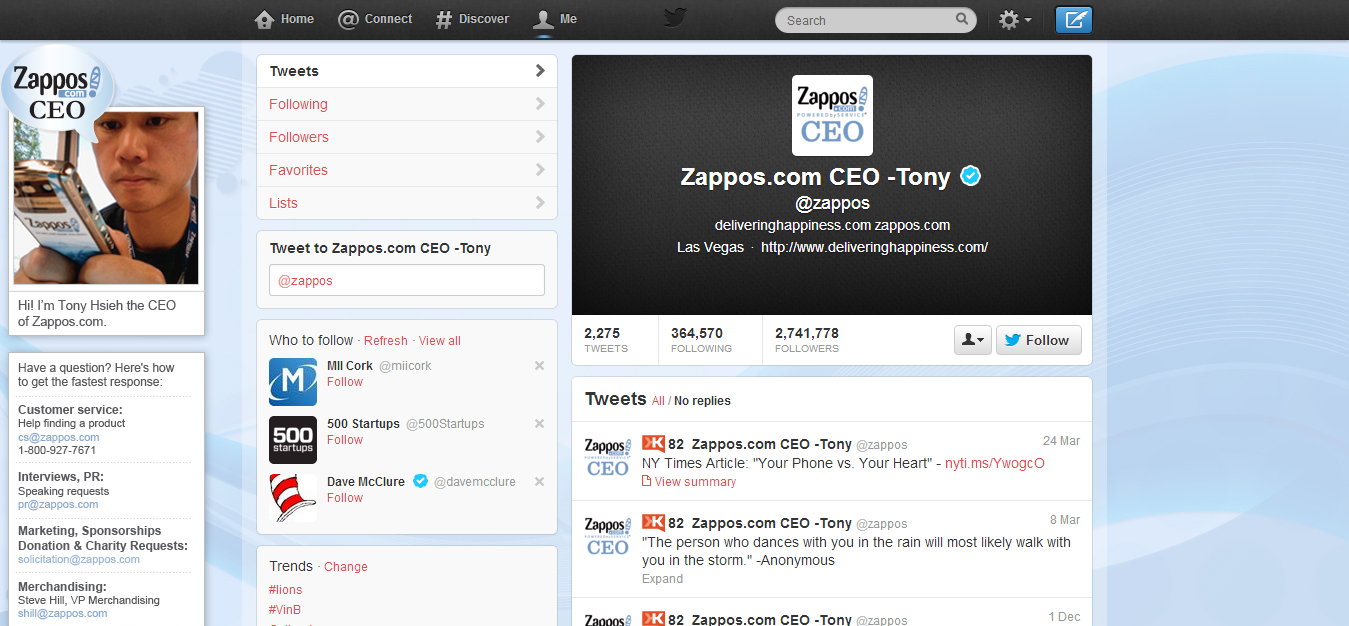
Led by their Inspirational CEO Tony Hsieh (who has 2.7 million followers) their strategy for Twitter revolves around an unusually open and transparent culture that encourages the use of social media across the business:
- All Zappos employees are on Twitter.
- Zappo’s Conversations page on their website uses Twitter’s API to look for all the Tweets that mention @Zappos and @Zappos_Service.
- They have also launched the Zappos TweetWall, which brings “the latest product finds and obsessions from the Twitter community”
# 2. Starbucks on Twitter
Starbucks are a social media superstar. The brand has almost 35 million fans on Facebook and nearly 9 million views on YouTube.
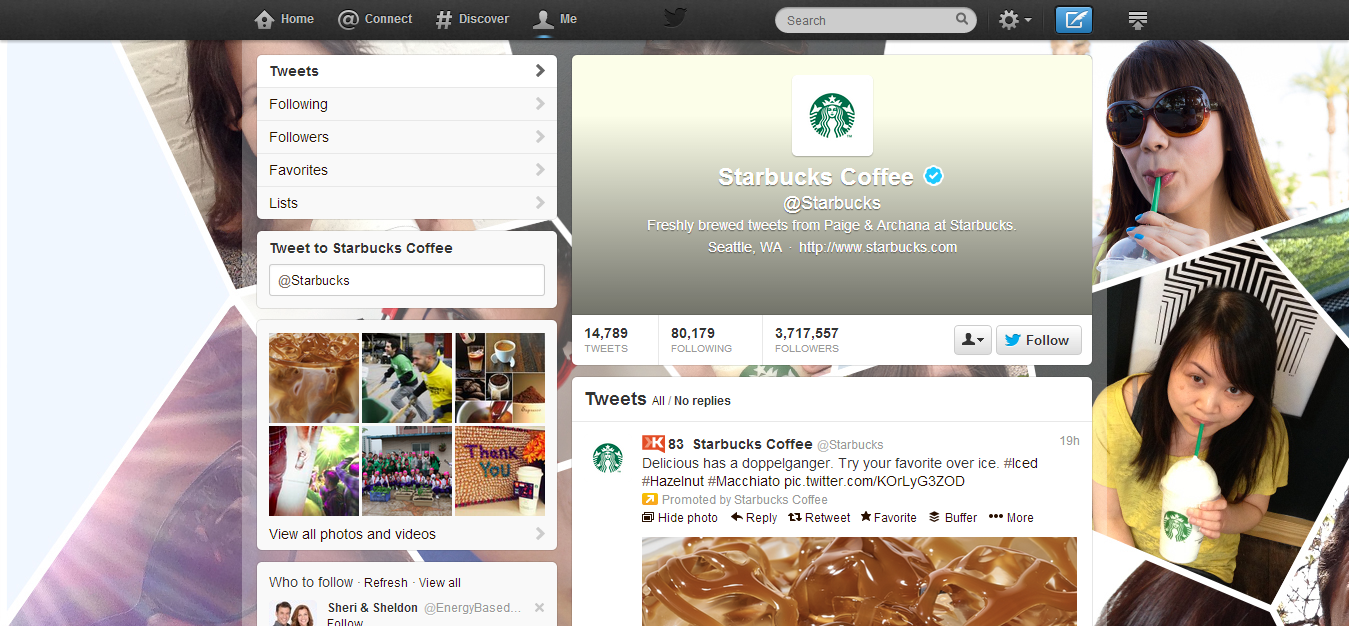
On Twitter, Starbucks 3.7 million followers ranks it fourth, behind Samsung Mobile, iTunes and NASA. And that’s just the main Twitter account, the company has many other accounts for it’s brands and international markets. The main Starbucks account tweets between 1 and 2 times per day:
- Pictures and Hashtags are used extensively and the brand focusses on building customer relations rather than promotion.
- Along with the @Starbucks account, the company has @MyStarbucksIdea.
- There, followers can send in ideas on how to make for a better customer experience. Starbucks then blogs about those ideas, which get put into action.
# 3. New York Times on Twitter
The New York Times is an example of a newspaper that has really embraced social media.
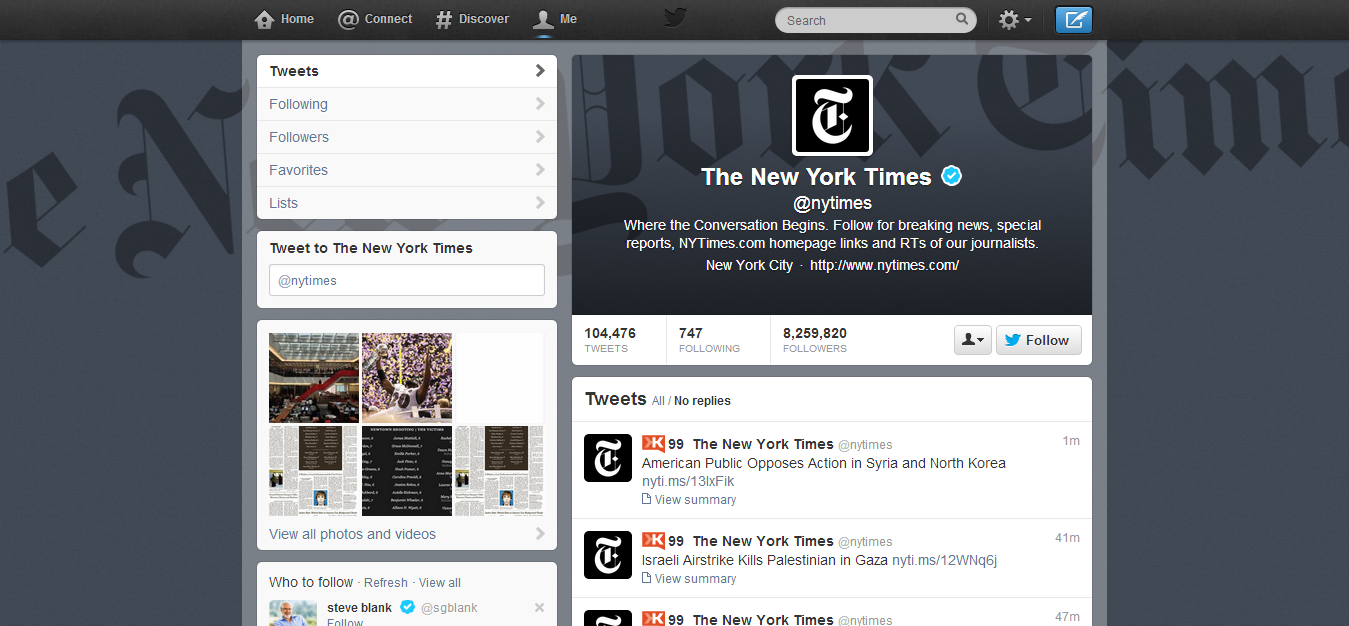
Their main Twitter account has 8.2 million followers and often tweets over a 100 times per day:
- Tweets include links to the NYTimes.com homepage and RTs of NYTimes journalists.
- Dozens of additional New York Times accounts such as @nytimesbooks, allow for additional targeting of their audience and segmentation.
- Those followers are receiving only the information that’s important to them.
# 4. Dell on Twitter
Another social media superstar, Dell’s ability to drive sales and customer service on Twitter has been well documented. However, they continue to deserve to be highlighted as an example of a large multinational that has become a genuine social business.
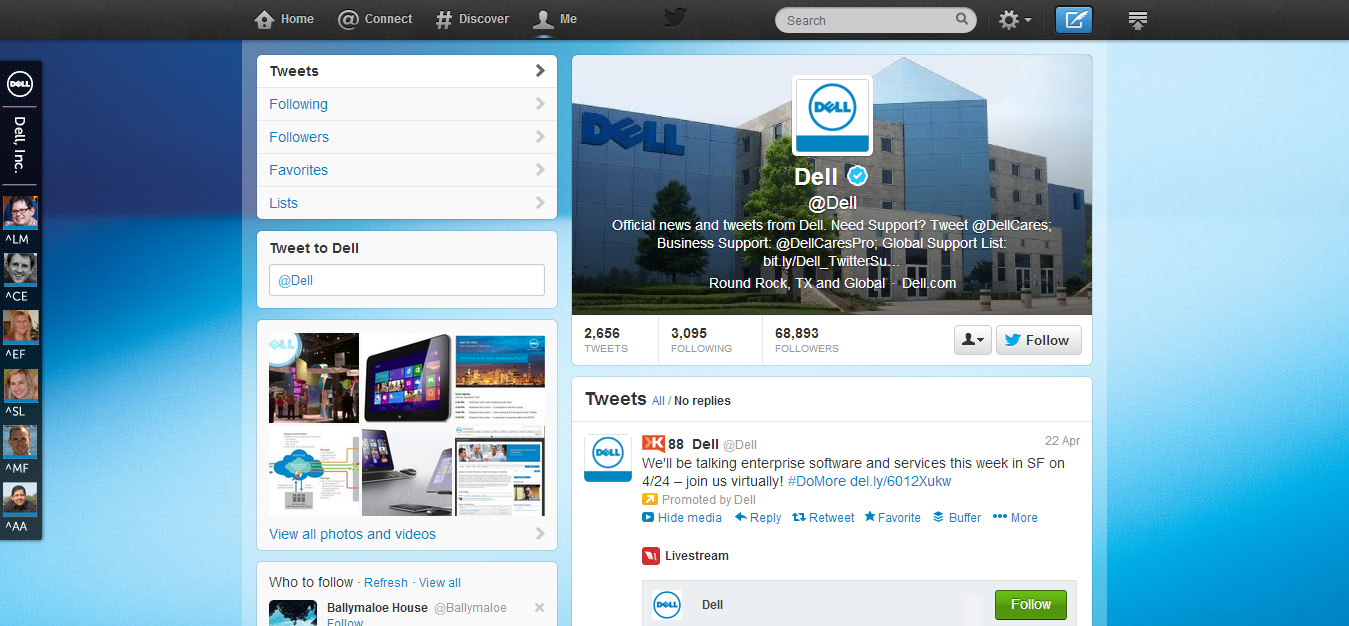
The main Dell Twitter account has just over 70 thousand followers and tweets up to 15 times per day.
- Dell has dozens of other Twitter accounts across their Support, Sales, Community and Corporate departments.
- Study their tweets and you will notice a great blend between PR, listening and selling.
- They also create weekly videos to thank customers as part of very the innovative #Delllove campaign.
# 5. SmallBizTrends on Twitter
Disclaimer: Anita Campbell is CEO of Tweak Your Biz, where I am a co-founder.
Led by Anita Campbell, “Small Business Trends is an award-winning online publication for small business owners, entrepreneurs and the people who interact with them”. The stable of websites includes: Small Biz Experts, BizSugar, Small Business CEO and Tweak Your Biz.

The main Twitter account (which is run by Anita) has over 100 thousand followers and tweets between 10 to 20 times daily.
- Tweets are made up of links to articles and information that small business owners would find useful.
- Anita also regularly engages with her followers and thanks them for their participation.
Conclusion
So having studied these Twitter accounts, there are a few similarities in their Twitter strategies that stand out:-
- Stick to the right blend between PR, listening and selling.
- Tweet relevant information that your audience and customers will be interested in.
- Use pictures and use hashtags.
- The CEO of the organisation needs to be on Twitter.
- Segment your audience by using different Twitter accounts for different aspects of the business.
- Use Twitter for customer service.
- Aim to integrate Twitter into the business.
Understanding the Digital Economy
Reports:

- Food and Drink Sector
- International Student Recruitment
- General and Health Insurance
- FMCG Sector – Retail and Ecommerce
- Attracting Top Tier Talent
- Social Media in Politics
Guides:
- Social Media Strategy
- Blogging
- SEO
- YouTube
- Google Analytics
- Adwords
- Google+
- Klout
- SMS Marketing
- Mobile Commerce
Contact us
If you would like to talk further about how Twitter can benefit your business, or if you would like The Ahain Group to help you along this path please feel free to contact us.
Connect: 


LinkedIn is the world’s largest professional networking and a social platform to manage your professional identity and brand. Are you making these silly mistakes that may damage your reputation and prevent you from taking advantage of the professional opportunities that exist on LinkedIn?

# 1. You still haven’t completed your LinkedIn profile
”Only 50.5% of people have a 100% completed LinkedIn profile“ LinkedIn.
The main reason that you should complete your LinkedIn Profile is to appear in the search results:
- LinkedIn’s internal search
- And Google
The Linkedin search algorithm displays results in order of:
- Profile completeness
- Connections in common
- Connections by degree
- Groups in common

LinkedIn ranks higher on Google than other profiles including other social media. If you are not appearing and getting found via Linkedin search, your profile remains dormant and creates a knock on problem when it comes to getting indexed and being found on Google.
Are you an ‘All-Star’?
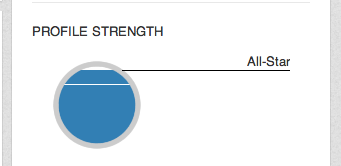
LinkedIn profile: ‘All-Star’ status
There are 4 levels to attain 100% Profile completion or ‘All-Star’ status:
- Beginner
- Intermediate
- Expert
- All-Star
What does it take to become an ‘All-Star’?
The profile sections you need to complete to get to ‘All-Star’ status (100%) are:
- Your Industry and Location
- Current Position with description
- 2 Past Positions
- Your Education
- Your Skills (minimum of 3)
- A Photo (200 by 200)
- At least 50 Connections
# 2. You haven’t customised your LinkedIn profile’s URL
Custom public profile URLs are available on a first come, first served basis and significantly increase the SEO value of your Profile.
- When you create a LinkedIn profile, you are given an automatically generated URL for your profile including an eight digit number. You can customize this URL (edit your public profile from the Settings page) so that your public profile can include your name: http://www.linkedin.com/in/nialldevitt.
- Then use your Public Profile URL on the web to improve your ranking.
# 3. You send your LinkedIn connection requests without personalising them
LinkedIn is the largest professional networking opportunity there is and sending a connection request is the first (and perhaps only) opportunity you get to make an impression. The standard LinkedIn connection request reads likes this:
“I’d like to add you to my professional network.
- Niall Devitt”
What many people don’t realise is that it’s shouldn’t be used for an actual connection request. It is merely a templated starting point towards you writing the request.
Or putting it another way, sending the standard request without first personalising is the same as attending a real world networking event and:
- Approaching someone to network with and
- Forgetting to say hi and introduce yourself and
- Forgetting to find out their name or anything about them and
- Forgetting to give any reason for why you approached them and
- Expecting them to exchange business cards.
It would leave a pretty awful impression, don’t you think?
Most professionals would never dream of networking like this at an event, yet many do it every day on LinkedIn.
# 4. You spam your network

The above request came from someone in my network. Let me be clear, I am sure that this person meant no malice in sending out this request; in fact I’d say the person was entirely sincere in their objective to “put LinkedIn to the test”. The first comment “Hello to everyone I am connected with on linkedin” tells me that this person is using LinkedIn to send out a blast e-mail to his connections with the purpose of “seeking part – time employment”.
Now some people might compliment this person for the endeavour and they may even respond to the e-mail, but let’s investigate if this is in fact putting “LinkedIn to the test”?
- If I was looking for work, I would not send out the same introduction to each and every company without finding out what they do, where I can bring value and who I would need to talk to.
- It’s just common sense and I’m sure that this person would not do this if seeking employment using more traditional means. However because they are using LinkedIn, they apparently believe the same common sense rules no longer apply.
- The reality is of course they do and what LinkedIn allows you to do is to apply them very efficiently. Spamming people and companies we already know would not work with traditional job search, so it will work even worse on LinkedIn.
Take what you already know and use LinkedIn to drive efficiency of effort. That’s really how to “put LinkedIn to the test”!
# 5. You never update your network or you bombard them with updates
Your status message allows you to share professional updates with your network:
- Remember out of sight, out of mind. It’s important to update your connections regularly.
- Your network will appreciate information but not excessive updates. LinkedIn users can choose to mute connections so excessive updating runs the risk of having your updates turned off.
Understanding the Digital Economy
Reports:
- International Student Recruitment
- General and Health Insurance
- FMCG Sector – Retail and Ecommerce
- Attracting Top Tier Talent
- Social Media in Politics
Guides:
- Social Media Strategy
- Blogging
- SEO
- YouTube
- Google Analytics
- Adwords
- Google+
- Klout
- SMS Marketing
Contact us
If you would like to talk further about how LinkedIn can benefit your business, or if you would like The Ahain Group to help you along this path please feel free to contact us.
Connect:
The Ahain Group are delighted to announce a new strategic partnership with Podio, the collaborative work platform with a brilliant new take on how everyday work gets done. Podio is a new way of working; it puts you in control of your work, rather than the other way around.
What is Podio?

“We needed a technology that would ensure our team have the tools to deliver a world-class service”
Podio unites your team, content, tasks and communications, enabling you to manage projects and run business processes like sales, recruiting and more – without email overload and document chaos.
Podio saves time, cuts costs and improves efficiency by adapting to your work style. Anyone can customise Podio workspaces with Podio apps that structure work to enhance collaboration with clients and colleagues.
Communication is handled in social activity streams, that improve transparency and speed up decision making. Being web-based and with free apps for iPhone, iPad and Android you can get work done wherever you’re most efficient.
Podio was founded in Copenhagen in early 2009 with the first customers signed up by August of that year. Since then the customer base has grown at a rapid rate. The company was acquired by Citrix Systems in 2012 and now over 200,000 organisations enjoy the speed of getting work done on Podio.
Why did we partner with Podio?
The Ahain Group are always looking for ways to streamline our work and strengthen our relationships. Our work requires us to digest and manage our client’s information. Each customer is unique in terms of their business goals as are the tactics that we implement to deliver as part of their strategic plan. At any one time, our customers, team and associates can be based in various locations within Ireland and abroad.
“We needed a technology that would solve complex challenges, get our work done and ensure that our team have the tools to deliver a world-class service” explains John Twohig, The Ahain Group Managing Partner who went on to say:
 “At The Ahain Group we believe that, before advising others, we ourselves must walk the walk. When we needed a solution we undertook to research the market to find the best product available. The platform should be capable of client and project management, document sharing and storage, be accessible via all devices, secure, flexible and integrate with the fast-moving digital age we live in. The one platform which stood above the crowd was Podio. We are very happy that we have now become their “Preferred Partner” in Ireland.
The Ahain Group Associate, Eileen McCabe, who had the task of finding the best solution to suit our needs, explains:
 “After researching a range of collaboration tools and platforms to establish the one that would best enhance The Ahain Group’s business flow we found that Podio was the perfect choice. Instead of having to organise our internal processes, workflow management and CRM around a generic structure, we found that, with Podio, we had the ability to customise workspaces and applications to incorporate our business strategy in the way that suited our internal management flow best.
The great thing about Podio is that if you do not find an application that suits a particular business strategy, you can use the in-built App Builder tool to optimize business solutions in the most efficient way possible. Podio’s unique flexibility allows the platform to be managed and constructed so that workflow processes and communications are efficient, effective and productive, all in the one place.”
Clonmel Chamber of Commerce
Clonmel Chamber of Commerce started using Podio in 2012, CEO, Brian Cleary describes how Podio has helped the organisation: ” We were using ACT 2010 and Excel individually to do lists, Mailchimp, Evernote and many other services. The problem was that there was a disconnect between those programmes and the team. I read about Podio and within five minutes of clicking the link, I had created my first app on Podio. It immediately made sense.
It acts as a CRM, although I prefer to call it a member relationship management system. Our work involves meeting hundreds of business people every month. Every one of these interactions is tracked in an app that we’ve built called ‘Touchpoints’. Different things matter to different business people. Tracking what matters enables us to see trends emerging and allows us to sort out an issue before it becomes a problem for the business community. The Chamber Database workspace contains all the contact information of all of the businesses that we deal with. We use the App Reference mechanism liberally to cross reference event bookings, issues, products bought, sectoral interests and more. In a way it is our attempt to build a big data picture of local businesses.”
What next for the Ahain Group and Podio?
The Ahain Group and Podio share a philosophy: “it’s not about technology, it’s about people”. The digital workplace we’ve built using Podio allows our team and clients to collaborate on, participate in and manage the success of their engagement - at every step and from anywhere.
As Partners in Ireland, The Ahain Group will shortly organise “Podio Centric” events at different locations, to help existing Podio users leverage more value from the platform and to introduce it to others.
Our goal is to make work places in Ireland as efficient and as stress free as possible.
Yesterday, I stopped into the Lucan Spa Hotel in Dublin, ordered a coffee and attempted to connect to their Wi-Fi, when a landing page informed me that I would need to purchase a voucher for access. Reception told me that this would cost nearly 5 euro (for less than an hour). On that, I left my coffee and found another hotel in the area.
I later contacted the Hotel on Twitter to voice my disappointment and was told that Wifi is only “provided complimentary to accommodation guests and conference delegates” and that they hoped that I enjoyed “availing of our free car parking, toilet facilities and water when in at the hotel”
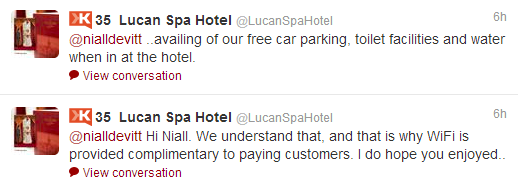
I don’t want to pick on the Lucan Spa Hotel specifically, they are not the only Hotel that continues to charge customers for Wi-Fi. Many other hotels continue to charge not just paying customers but staying customers as well!
The Irish Hotel product and Wi-Fi
The Irish hotel industry had been under severe pressure over the last few years. Hotels have had to lower rates and offer additional value to compete. The Hotel product in Ireland is generally of a high standard. The decision to offer free Wi-Fi (or not) is a commercial one. So does charging for Wi-Fi add to or take away from a Hotel’s bottom line?
Lost business
In my case, I would have bought my lunch and probably more coffee. I would have called back again and again. I use hotels for meetings at least every other day and I often host training/seminars etc. That said, I may not be a typical customer so I also asked my network on LinkedIn. Again, the general consensus was that free Wi-Fi is now a customer prerequisite.
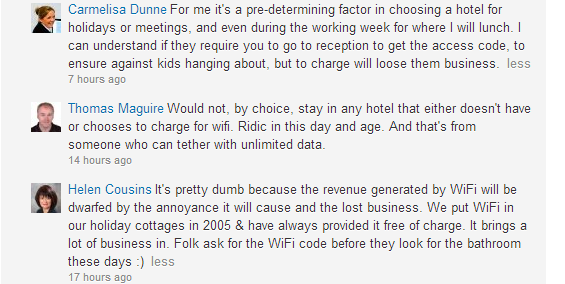
Customer satisfaction
According to the 2012 J.D. Power’s new hotel-satisfaction-index study: North American hotels that charged for Wi-Fi received satisfaction scores 76 points lower (on a 1,000-point scale) than those that didn’t.
“Guests enjoy Wi-Fi for free in many places outside of their hotel experience, such as in coffee shops, restaurants and other locations, setting expectations against which hotels are compared … When guests learn they have to pay for Internet or when connection speeds are slow at a hotel, they are much more dissatisfied than they were in the past” - Jessica McGregor, J.D. Power
Convenience and service
Industry expert, Daniel Edward Craig defends hotels by saying “you’re paying for convenience, quality, service and ambience. And you can’t work in your underwear at McDonald’s—I’ve tried. It’s the same reason you pay $8.00 for a can of Coke from the mini-bar when you can get it for $1.50 at the 7-Eleven”, he adds “As for hotels that don’t charge for wifi, you have the upper hand for now. If I were you I’d be singing it from the rooftops.”
Can hotels afford to keep charging?
So can a loss in revenues by providing customers with free Wi-Fi be offset against gains in increased custom and customer satisfaction levels? Well, honestly, I don’t have enough evidence to say for sure. However, I’ve not seen any hotels that offered free Wi-Fi reverse their decision to. While there may be some evidence that customers at the top end of the market are perhaps not bothered, I would suggest hotels that target:
- Price sensitive
- Business
- Or younger customers
Are probably putting themselves at a competitive disadvantage by charging and the reality is that now covers the majority of Irish Hotels.
To be fair to the Lucan Spa Hotel, they appear to be focused on weddings and they do offer free Wi-Fi to guests. Oh! and they provide free car parking, toilet facilities and water so if you’re ever on the M4, thirsty and need to go to the toilet - you know where to stop! 

Pic: Go Ireland
Lucan Spa Hotel Response:
The Marketing manager at the Lucan Spa hotel has since contacted me saying, “I would like to apologise for my curt demeanor over our Twitter interactions”. He added that “it is the hotel’s current policy to offer complimentary WiFi to guests who stay overnight” and “to delegates of meetings and conferences”. They also provide other complimentary services such as “car parking, complimentary tops ups of tea and coffee” and “special room rates packages” They agree that “WiFi is a huge attraction to customers” and while ”the hotel is currently not in a position to offer complimentary WiFi to all guests”, as they are tied into a contract. They are looking to change this to providing “free (or at least heavily discounted) WiFi to all guests” ASAP. They would be “delighted to issue me with a complimentary WiFi voucher” should I return to the hotel in the future. I’d like to thank the Lucan Spa for talking the time to respond and say that there are genuinely no hard feelings on my end.
Understanding the Digital Economy
Reports:
- International Student Recruitment
- General and Health Insurance
- FMCG Sector – Retail and Ecommerce
- Attracting Top Tier Talent
- Social Media in Politics
Guides:
- Social Media Strategy
- Blogging
- YouTube
- Google Analytics
- Adwords
- Google+
- Klout
Contact us
If you would like to talk further about how we can benefit your business, or if you would like The Ahain Group to help you along this path please feel free to contact us.
Connect:
Are you struggling to increase blog traffic for your business? My group blog, TweakYourBiz.com, reached the milestone of 100,000 unique visits during December, 2012, and in a blogging niche that is very competitive. Here are 10 critical tactics that you must do if you really want to increase blog traffic for your business.
Increase blog traffic for your business
# 1. Discover what works, then repeat, improve, repeat….
There is no silver bullet to growing blog traffic:
- It requires hard work and new bloggers need to have a long term mind-set. The more you are prepared to put in, then the more you will eventually get out.
- The graph is exponential, or, in other words, it’s slow at the start but gathers pace over time. Be assured that consistency does pay off and success will breed more success, and more traffic.
Again, there is NO silver bullet to growing blog traffic. You need to discover what works, repeat, improve, and repeat again. Your blog is Rome and if you don’t understand that - don’t blog.
# 2. Define your audience
It amuses me that so many bloggers who write for “no one in particular” are disappointed when no one reads their blog? If, on the other hand you would like actual people to read your blog, well then you will need to define who your audience will be:
- Some niches will be very competitive and others less so.
- And you will need to factor this in to your blogging strategy. Who are the competitors for your audience? How good are they? And what can you learn from them?
- I define a sub-set of my audience for every post I write. Are you part of this sub-set?
# 3. Find out what customers need to know, not what you’d like to tell them
Many business bloggers struggle with coming up with ideas for blog posts, but what they don’t realise it that it’s not them that should be coming up with the ideas in the first place. I’m never stuck for ideas for content because I have a simple, but very effective, tactic for deciding what to write about - I LISTEN to my customers!
If you really listen, you will never be stuck for ideas for blogs. In fact, you will always have too many and the challenge will instead be deciding on which one will give the greatest ROI for your business.
# 4. Answer your customers’ questions and do it REALLY well!
Now here’s where the skill and dedication come in. When you search for answers to your questions, problems or challenges online, what content and which bloggers make the most impact?
- Those bloggers who partially answer your question?
- Or those, that might know the answer if you were to become their customer?
- Or those that give you the best answer?
Visitors to your blog will only consider becoming your customers when your content proves that you’re the best. Bad content is not better than no content, it’s worse! If it looks like it took you five minutes!
Writing content that will get you customers takes time, skill and dedication.
# 5. Plan to publish often, not just when you feel like it
Remember Rome?
- To grow a large audience, you will need to publish at least 3-4 times per week.
- Frequency can be counter-balanced, to an extent, by increasing quality, but frequency remains a critical element in achieving growth.
- One way to increase frequency without increasing writing time is to select and invite guest bloggers.
# 6. Do keyword research and SEO, and do it for every single post you write
Keyword research and SEO are skills that all bloggers can learn and become proficient at. There is very little rocket science involved (See our guide on blogging).
So why don’t many bloggers do it?
Probably because SEO is an extra task and the results aren’t immediate. That said, unless you want to blog with one metaphorical leg and hand tied behind your back, it’s another critical element of blogging success.
Not doing SEO on one post is silly, on ten, it’s stupidity and on fifty, consider yourself insane!
# 7. Research every single post you write
If you’re like me, and you prefer to read those bloggers that give the best answer, or do business with those companies that will give the best solution, you’ve probably already realized that our customers will expect the same?
I know lots about my space, but its still only a fraction of what’s to know.
- Therefore when I answer my customers’ problems through my blogs, I realize that researching every post is key to me in doing so.
- I don’t want to steal other people’s ideas, or content, and of course I will credit where appropriate (see networking below)
- My research not only makes my content better but it also educates me so that I become better at what I do.
Google can become the greatest teacher you’ve ever had, so use it. And wait for it, it’s free!
# 8. Learn how to create great headlines
Your headline is the first (and possibly only impression) you make on a perspective customer. They’re really that important.
Rather than me take you through how to create great headlines (Research, Google, again). Let me ask you a question, would you be reading these words, if not for my headline?
# 9. Format your content for the Internet
The online reader discovers and reads content differently.
- They don’t read top to bottom, they scan first.
- Therefore you need to learn how to format your blog posts for the internet.
(Again, see our guide on blogging)
# 10. Network like you mean it!
Great content will only get you so far, networking will take you the rest of the way!
Make sure to build a blogging strategy that includes:
- Leaving comments on other blogs.
- Linking out to other blogs and bloggers
- Engaging with and sharing content from bloggers on your social media channels.
- Guest posting and inviting people to guest post on your blog.
Understanding the Digital Economy
Social business reports
To download our industry specific and researched social business reports, click here.
Guides
- Social Media Strategy
- Blogging
- YouTube
- Google Analytics
- Adwords
- Google+
Contact us
If you would like to discuss business blogging with The Ahain Group, please feel free to contact us.
Connect: